
Imagine asking your phone, “Find me a good laptop bag under $100 and buy the best one,” and within seconds, the AI assistant not only finds options but completes the entire purchase for you—without you ever opening a browser or filling out a checkout form. Sounds like science fiction? Not anymore.
On January 11-12, 2026, Google unveiled the Universal Commerce Protocol (UCP), a groundbreaking open standard designed to revolutionize how AI agents handle online shopping. This isn’t just another tech announcement—it’s a fundamental shift in how we’ll buy things online. With backing from retail giants like Shopify, Walmart, Target, Etsy, and Wayfair, plus payment powerhouses like Visa, Mastercard, PayPal, Stripe, and Adyen, UCP aims to solve one of the biggest problems in AI-driven commerce: the dreaded checkout breakdown.
In this detailed guide, we’ll break down exactly what UCP is, how it works, why it matters, and what it means for both shoppers and businesses—all in plain English.
Key Takeaways
- UCP is an open standard created by Google with major retail and payment partners, enabling different AI assistants to complete purchases reliably across multiple stores
- It covers the entire shopping journey: product discovery, checkout, identity verification, and post-purchase order management
- Merchants stay in control: You remain the Merchant of Record and can choose between “native” or “embedded” integration approaches
- Big-name support: Launch partners include Shopify, Walmart, Target, Etsy, Wayfair, Visa, Mastercard, PayPal, Stripe, and Adyen
- The bottom line: Fewer failed checkouts, lower costs for businesses integrating AI, and faster purchasing for consumers—though important questions remain about data privacy and competing standards
What Exactly Is the Universal Commerce Protocol?
Let’s start with the basics. The Universal Commerce Protocol is essentially a shared language—a standardized set of rules and API calls—that allows AI agents (like Google’s Gemini, or potentially Amazon’s Alexa or Apple’s Siri in the future) to interact seamlessly with any merchant’s system and payment providers.
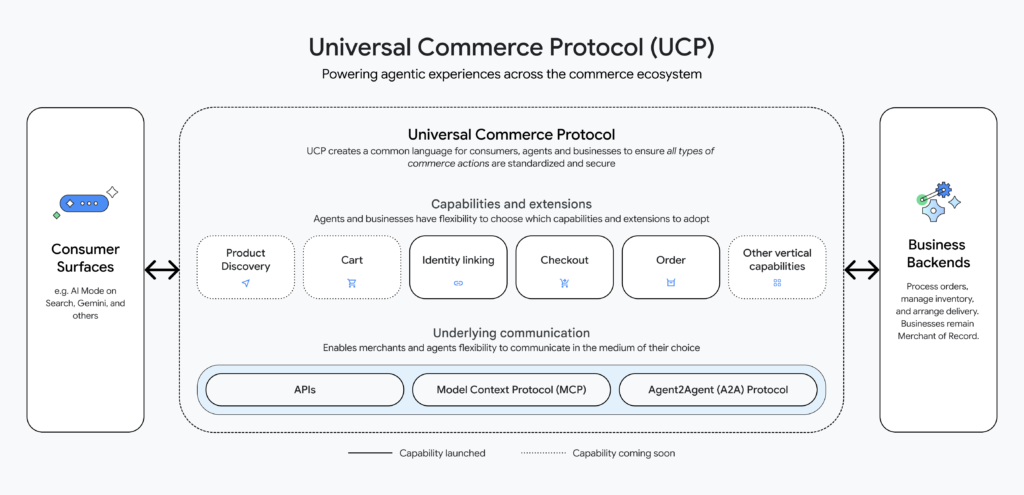
Think of it this way: Right now, every online store has its own unique checkout process. One might ask for your shipping address first, another wants your email, and each has different payment options. For AI agents trying to help you shop, this creates chaos. They’d need custom integrations with every single store—thousands of different “handshakes.”
UCP changes that game entirely. It’s like creating a universal translator so every store speaks the same commerce “dialect.” Your AI assistant can now browse products from multiple shops, add items to carts, and complete payments using one standardized approach. No more messy, one-off integrations. No more checkout failures.
Read more: What are AI Agents? Complete Explanation: Definition, Types
How UCP Actually Works: A Real-World Example
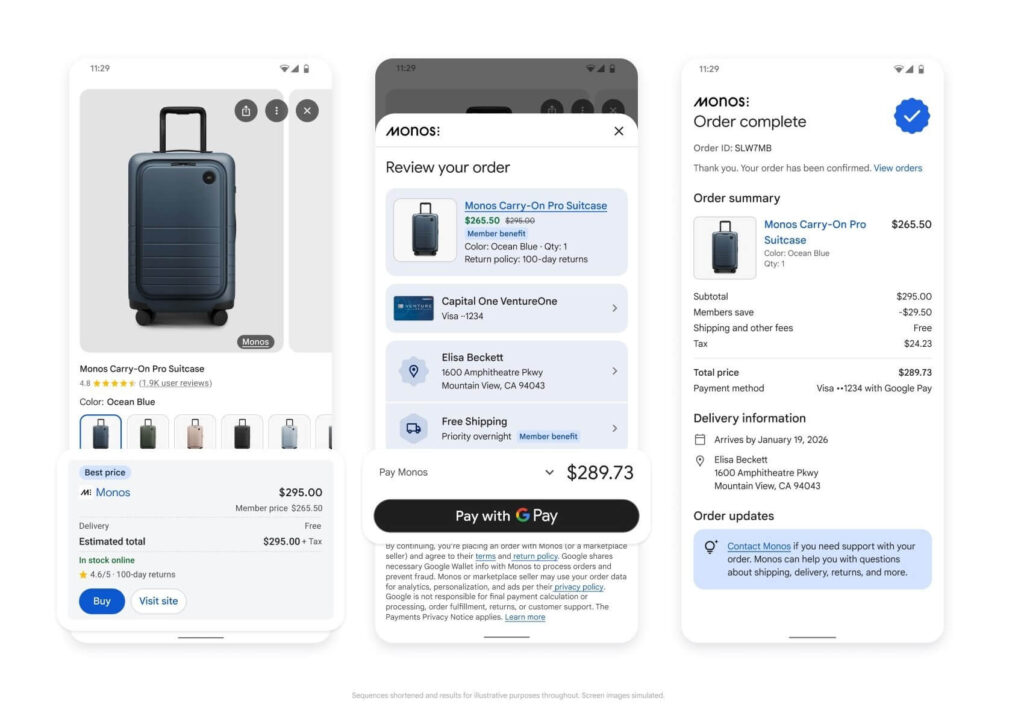
Let’s walk through a practical scenario to see UCP in action:
Step 1: The Request You tell your phone’s AI assistant: “Find a durable 25-liter daypack under $120 and order the best-rated one.”
Step 2: Discovery The agent searches participating merchants using UCP’s discovery features. Instead of scraping outdated web pages, it queries each store’s live inventory system directly. It checks real-time stock levels, current prices, and customer ratings.
Step 3: Selection The AI shows you three options. You say, “Buy the second one.”
Step 4: Checkout. Here’s where UCP shines. The agent creates a cart using UCP’s checkout system and opens a payment flow. It can use Google Pay, PayPal (coming soon), or another supported wallet.
Step 5: Identity Confirmation The protocol securely verifies your identity, shipping address, and payment method—all with your consent.
Step 6: Completion The merchant confirms fulfillment options (standard shipping, express, etc.), and the agent finalizes the order. The merchant remains in full control as the Merchant of Record, handling pricing, taxes, and refunds.
The entire process happens in seconds, replacing what used to require multiple tabs, form fills, and potential errors with one smooth, standardized conversation.
Core Components Explained (In Simple Terms)
UCP isn’t just one thing—it’s a system with several key parts working together:
1. Discovery and Capabilities
This is how AI agents find what merchants offer. Instead of asking, “Do you have products?” the agent can ask specific questions: “Do you have men’s small in green? What’s the current stock count? What shipping options are available?”
Example: If you’re looking for hiking boots, the agent can instantly query ten different stores to see who has your size in stock, compare prices, and check shipping times—all without loading a single web page.
2. Checkout Primitives
These are the building blocks for completing a purchase. Think of them as standardized commands: “Create cart,” “Apply discount code,” “Select shipping method,” “Finalize payment.” Each command works the same way across all UCP-enabled stores.
3. Identity Linking
This securely confirms who you are and saves your preferences—shipping addresses, loyalty program numbers, payment methods—with your explicit consent. It’s like having a verified ID card that works everywhere, but you control when and how it’s used.
4. Order Management
After you buy something, UCP handles everything else: order tracking, cancellations, returns, and status updates. Your AI can answer questions like “Where’s my package?” without sending you to log into different store accounts.
5. Payments Compatibility (AP2)
UCP works with Google’s Agent Payments Protocol (AP2), ensuring that when an AI acts on your behalf, payments are secure, authenticated, and auditable. Your sensitive payment data stays protected.
Who’s Behind This and Where You’ll See It
Google didn’t build UCP in isolation. This is a collaborative effort with massive industry backing:
Retail Partners: Shopify, Etsy, Wayfair, Target, Walmart, and others have publicly committed to supporting UCP, meaning merchants using these platforms can become “reachable” by AI agents.
Payment Partners: Visa, Mastercard, Stripe, Adyen, and soon PayPal are integrating their systems to work seamlessly with UCP’s payment flows.
Where to expect it: Initially, you’ll see UCP-enabled checkout in AI Mode in Google Search and the Gemini app. As adoption grows, expect other AI platforms to integrate it as well.
Why Merchants Should Care (And What They Keep)
If you’re a business owner, you might wonder: “What’s in it for me, and what am I giving up?” Good news—UCP is designed with merchant interests in mind:
Benefits:
- Wider Reach: Your store becomes accessible to multiple AI assistants without building separate integrations for each platform. One integration, multiple channels.
- You Stay in Control: This is crucial—you remain the Merchant of Record. You keep control over pricing, tax settings, fulfillment methods, and return policies. UCP provides access without taking away your authority.
- Flexible Integration: Choose between two paths based on your brand needs:
- Embedded Path: Keep your checkout page and brand experience intact; UCP just creates a secure entry point for agents.
- Native Path: Let agents handle more of the checkout flow for faster purchases, while you maintain policy control.
What This Means for Shoppers
The Good Stuff:
- Faster Purchases: No more clicking through multiple pages, filling forms, or dealing with broken checkout flows. From “I want this” to “I have it” happens in seconds.
- Unified Information: Your AI assistant becomes your shopping concierge—checking order status, tracking shipments, processing returns—all through simple conversation.
- Better Discovery: Agents can compare prices, check real inventory, and find the best deals across multiple stores simultaneously.
What to Watch Carefully:
- Privacy and Consent: Identity linking and stored payment information require transparent handling. Always understand what your AI agent can do on your behalf before enabling agent purchases.
- Standards Competition: While open protocols benefit everyone, competing standards from other tech giants could create confusion if they don’t work together.
- Purchase Oversight: Make sure you can easily review, modify, or cancel agent-initiated purchases. Convenience shouldn’t mean losing control.
Simple Analogies to Understand UCP
Still feel a bit fuzzy on the concept? Here are two analogies that make it crystal clear:
The Phone Network Analogy: Today’s AI shopping is like calling different shops where each has a different phone system, language, and requires you to repeat all your information every time. UCP is like creating a standard phone network with one verified caller ID—all shops understand the same commands, and you only verify yourself once.
The Email Analogy: Think about how email works. You can use Gmail, Outlook, or Apple Mail, and they all talk to any email server because they use standard protocols (SMTP, IMAP). UCP aims to do the same thing for AI agents and commerce systems—one standard language everyone speaks.
Implementation Options for Businesses
If you’re a merchant wondering how to get started, here’s what you need to know:
Embedded Integration: Keep your existing checkout page and brand experience. UCP simply creates a secure conversation that guides users into your checkout. This option is perfect if maintaining full brand control is essential.
Native Integration: Allow AI agents to handle more of the checkout flow using UCP’s standardized commands. This creates faster checkout experiences on agent surfaces but requires careful consideration of policies and user experience.
Platform Support: If you’re using Shopify or another major e-commerce platform, check their published UCP tooling—they’re building integrations to make onboarding straightforward.
Google has published developer documentation with step-by-step guides and sample flows to help technical teams implement UCP.
The Bigger Picture: Agentic Commerce
UCP isn’t operating in isolation—it’s part of a larger shift toward “agentic commerce,” where AI doesn’t just recommend products but actively completes transactions on your behalf.
Google is building an entire ecosystem around this concept:
- Agent Payments Protocol (AP2) for secure transactions
- Business Agents for merchant interaction
- Merchant Center updates for inventory management
- Direct Offers in Ads for promotions
Expect other major tech companies to propose their own standards or complementary specifications. For UCP to truly succeed, the industry will need broad adoption and clear, enforceable privacy regulations.
Frequently Asked Questions
Q1: Is UCP live right now, and where can I use it?
A1: Google announced UCP at the National Retail Federation conference in January 2026. Initial rollout is happening in AI Mode within Google Search and the Gemini app, in supported markets and with participating merchants. Broader availability will expand over time as more businesses integrate the protocol.
Q2: Will merchants or AI agents see my payment information?
A2: Payment flows use secure digital wallets like Google Pay or PayPal (coming soon) along with agent payment protocols. Merchants receive only the information necessary to complete your order—not your full payment credentials. Identity linking and consent mechanisms are built into UCP. Always review privacy terms for each service before enabling agent purchases.
Q3: Do merchants lose control of their business or customer data with UCP?
A3: Absolutely not. UCP is specifically designed so merchants remain the Merchant of Record with full control over pricing, fulfillment methods, return policies, and customer relationships. The protocol simply standardizes how AI agents request and receive functionality—it doesn’t transfer business control or ownership of customer data.
Q4: Is UCP open-source?
A4: Yes, Google describes UCP as an open standard intended to be community-driven. Developer documentation and implementation guides are publicly available, allowing any platform or AI assistant to integrate the protocol.
Q5: How is UCP different from existing commerce APIs?
A5: Traditional commerce APIs are merchant-specific—each store has its own API with unique endpoints, data formats, and authentication methods. UCP is a unified protocol built specifically for agent-to-merchant interactions, covering the entire journey from discovery through checkout to post-purchase support. This dramatically reduces the need for one-off custom integrations.
Q6: Should I trust AI agents to make purchases for me?
A6: Trust should be based on transparency and control. Look for clear consent mechanisms, visible receipts, and the ability to review or cancel orders before finalization. Always monitor your payment accounts when you first enable agentic purchases. As the technology matures, regulations and best practices will help establish trustworthy standards.
Final Thoughts
The Universal Commerce Protocol represents a technically sound and potentially transformative step toward making AI an active shopping partner rather than just a recommendation engine. With backing from major retailers and payment providers, UCP has real momentum behind it.
However, its success depends on several factors: widespread adoption beyond the initial partners, transparent privacy and consent mechanisms, clear regulations protecting consumer rights, and how the industry navigates competing standards from other tech giants.
For consumers, UCP could make the “buy” step nearly invisible—in a genuinely helpful way—eliminating friction and frustration from online shopping. For merchants, it offers a manageable path to participate in the AI commerce revolution without losing control of their business or brand.
As AI assistants become more capable and trusted, protocols like UCP will define whether that future feels empowering or invasive. The technology is here. Now comes the crucial work of getting the implementation, privacy protections, and user experience right.
The future of shopping isn’t about clicking through websites—it’s about conversation. And UCP is the language that makes those conversations work.

